
Stowupland Hall in the 1930's and 40's
Our knowledge of the Hall during this time is mainly thanks to Thomas Carter’s granddaughter who passed information and documents accumulated by her mother Ena Carter to SHLG. Ena married Jack Carter, one pf Thomas’ three sons.
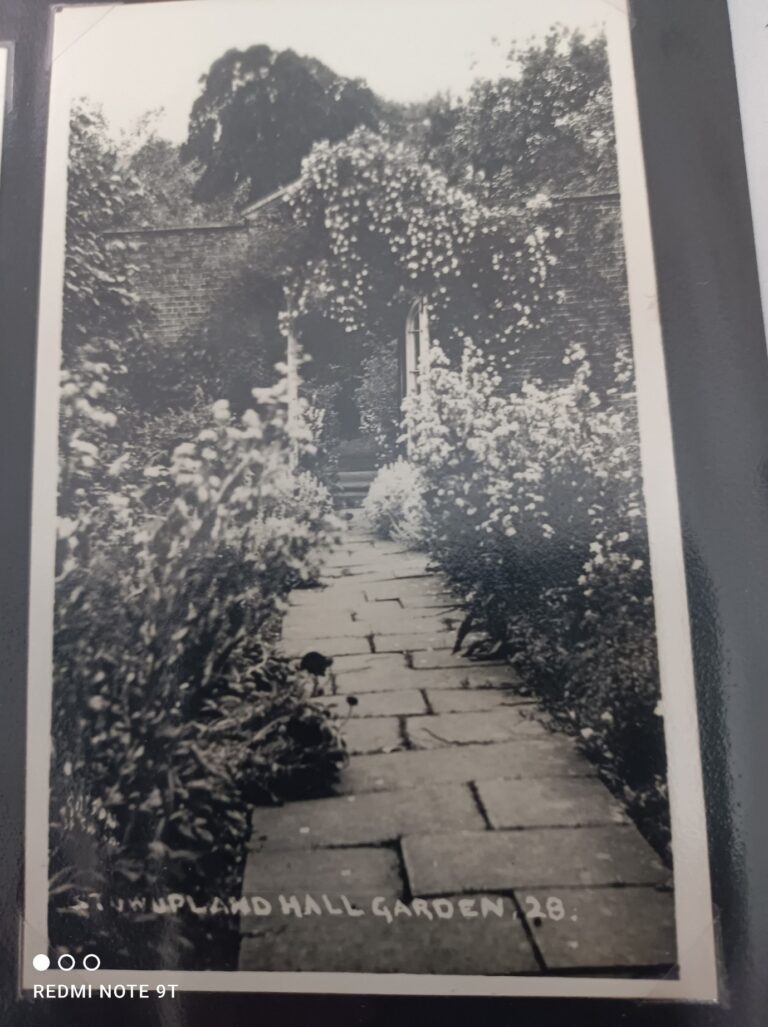
This photo shows the garden to the rear of the Hall.
Telstar of July 2013 carried an article of some memories of a Mr Luxford which had been first published in the December 1997 edition. He had reflected on his memories of working at Stowupland Hall in the 1940s to 50s.
John Luxford had gone to work for Mr Robert Black at the Hall as a live-in student. The housekeeper was m
Mrs Arbon with Jane Shave as a helper. Also living in the Hall were Paddy Atkinson and George Macdonald.
John discribed the farm as a mixed farm, ‘growing wheat, barley, sugar beet, re clover for hay (stover), wild white clover for seed, peas for picking, turnips and even a field of blackcurrants’. Other employees were Mr Alfred Cooper and his son Frank, Hubert Shave (horseman), Ken Thrower, Stan Southgate, Sid Whitto, Archie Buckle, Bo Brett, Ray Thrower, Robin Horrex, David Frost, Dougie Greeen and Kipper.
The tractors were mostlry Minneanoplis Moline (American but supplied and imported by Frank Nunn from Elmswell) but John still remembered there being half-a-dozen working Suffolk Punches.
‘A lot of bullocks were kpt on the farm, so a lot of muck was produced which was carted out to the field by horse and tumbril and left in heaps to be spread by hand, holding a muck fork of course! The sugar beet were drilled by a Smythe drill pulled by a pair of horses. When they came up they were first horse-hoed between the rows, then they were topped out by hand-hoe leaving a plant every 7 – 10 inches, and only one! We were paid ‘piece’ work for this, and I remember that after the first week I owed the boss money as I was rather slow but I improved.!
‘Harvesting was done with a binder, and the sheaves were shacked up and then carted to be stacked in the stack yard to await the threshing machine later in the year. In fact if you told us that 50 years later you would have to go to the Rural Life Museum down Stowmarket to see this – I don’t think we have have believed you. We did have a little combine, M.M again, towed by a tractor. The corn was bagged up inot comb sacks, 2 ct for barley, slid down the chute, picked up by hand pater and loaded onto tractors and trailers.
of course it was not all work. The very first day I arrived I was taken to the Stowmarket Young Farmers , where I met a lot of local young farmers some my friends to this day. The I went to Boys Brigade Hut to join the W.I. Old Time Dancing class run by Mrs Shoesmith who came from Stowmarket. The hut is no longer there. After the village Hall was built it became an apple store, then disappeared altogether when the Pippins development was built. I am really glad I went to the dancing class as I met the young lady who was to become my wife five years later.
‘I had a motor bike, so Saturday we used to go to Stowmarket, filling up with petrol at Mr Jack Burch’s who had two pumps at the side of the road where Leek’s garage is now, then waited at the level crossing for the steam train to go through, whereupon the signal man in his hut used to turn a big wheel to open the gates. It was rumored even then that a bridge was to be built over the railway – and that was 50 years ago! Then onto the pictures if the queues were too at the Regal we used to go to the Palladium down Ipswich Street, which was not quite so smart.
‘A highlight of the year was the annual Flower Show and fete held on the park beside the Hall. A marquee was put up for the flowers and vegetables and a Grand Ring for the displays – including one year the Dagenham Girl Pipers. There was a cart-horse Derby, very thrilling as they (the horses) were quite large and had no brakes.
Looking back I enjoyed my time at Stowupland Hall.
Read other examples of farming in Stowupland.
