Some Reminders of Conflicts

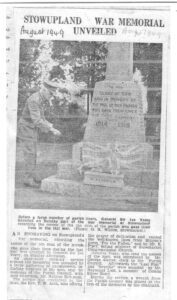
Our most important reminders of past conflicts can be found on our war memorials in Holy Trinity Church and in the cemetery. In 1949, as can be seen here, a large number of parishioners gathered for a service led by the Rev Arch for the unveiling of the names of local 10 men who lost their lives in WW2.
However there are other reminders scattered across Stowupland’s landscape which also have stories to tell about past conflicts. some structures can still be seen others only remain as memories.
We are accumulating some personal memories of Wartime Stowupland. Jack Carter shared some of his memories in an oral history project, the full transcript is held at the Suffolk Record Office. Here are just a few of his memories from WW1.
Jack was born in 1912 so he was very young when WW1 commenced, but he recalled ‘as a small boy standing on the garden gate, near the road, watching the Cheshire regiment, I think they were, march past with their rifles and their picks and their shovels, go and dig the second line of defense trenches.’ He thought they were stationed in Stowmarket in the ‘Old Hopple Yard’.
He remembered an airplane landing landing on the Stowupland Green as it had run out of petrol ‘the pilot had to spend the night at the village shop and wait until the next day to get some more petrol. When it took off the green was a bit lumpy but it did get off, but it didnt seem to rise very high, and it was flying very low and it caught the top of some ash stubs down what we call rental lane {sic} and it crashed and it smashed the whole thing pieces but the pilot luckily escaped he wasn’t injured at all’.
BB Hut – From the 1920s to the early 70s an old hut stood near the Crown public Inn. It had been erected in Creeting St Peter during WWI as a gun-site hut.but after the war it was moved to Stowupland and used as a meeting hut and then for storing apples.
During WWI a searchlight stood on Elm Farm land (opposite the top of Mill lane). For a time the soldiers were billeted at Green Farm across the Green.(note made by Ena Carter)


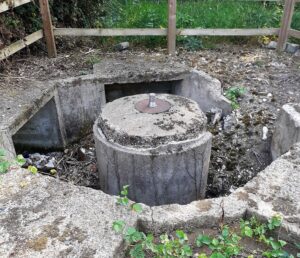
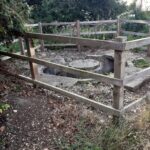
These photos were taken by our researcher Neil Langridge and as can be seen the area is protected and the site is now preserved.
Monument record SKT 078 – WWII Spigot Mortar emplacement located near Hill Farm, Stowupland Road, Stowmarket.
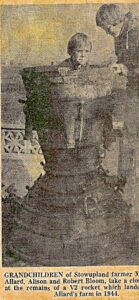
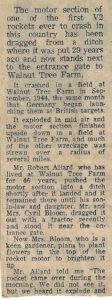
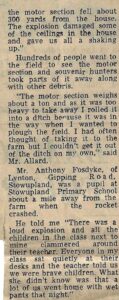
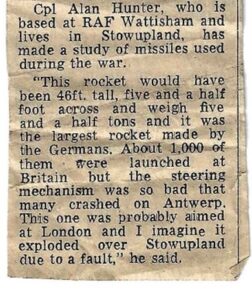
In 1973 a local farmer decided to make good use of an old V2 rocket engine that had lain neglected in the ditch of one of his field for for 3 decades. Father and son-in-law dragged it to their farm drive way and turned it into flower planter. It is now in Flixton Museum (Taken from a news paper cutting on Nov 2nd 1973).


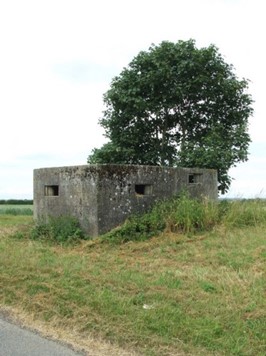
Pillbox FW3/23 Stowupland,. Have you seen this ‘pill box’ along Gipping Lane?
This casemate is of type FW3/23. During World War II, these bunkers were used for the defence of the United Kingdom against a possible enemy invasion. They were built in 1940 and into 1941. The personal who manned this defensive position were billeted at Gipping Farm with the Carter family.

Ena’s daughter remembered being told by her Mum that the men had the use of the Gipping Farm dining room which was underneath the Carter’s bedroom so they were here when it was a change of shift. The soldiers did their own catering etc. It is thought there would have been a searchlight in the vicinity.o.
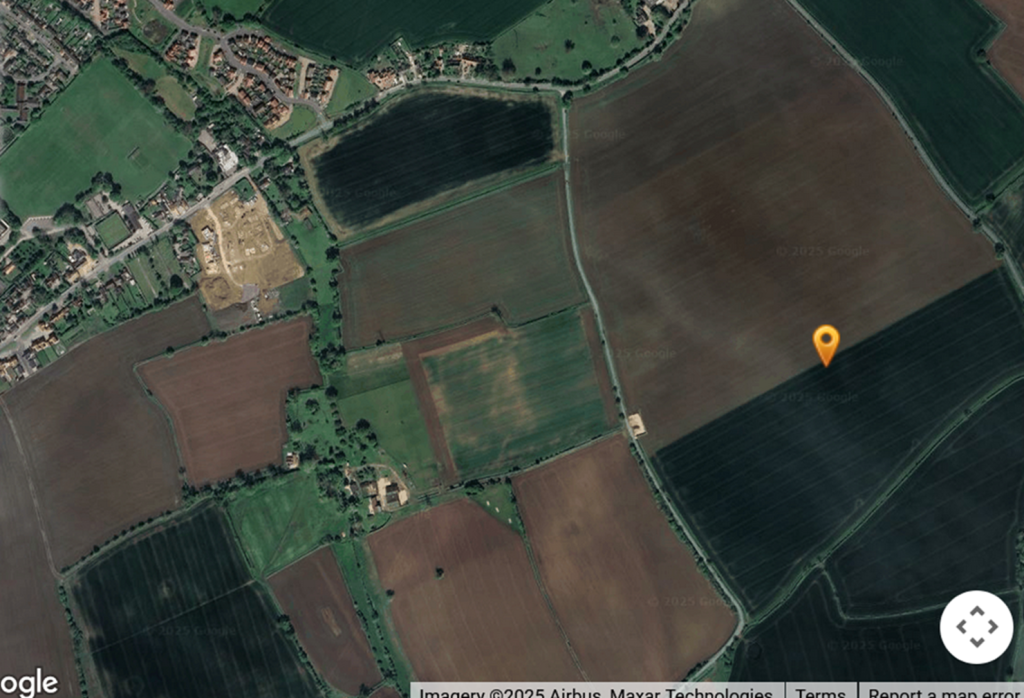
This map helps to locate the position of a WW2 ‘Y’ station receiving post. (Grid Ref TM 08219 59814.) It was in position by January 2nd 1941 and used Direction Finder technology to home in on VHF signals to either locate enemy aircraft or for RAF navigation. The station was most likely a hexagonal wooden tower about 6 m tall with a concrete base with aerials on the roof. We don’t think even the base remains. The 1939 survey gives us 4 local people who may have been involved in its operation: Percy Kerry (age 32, Civilian RAF telephone operator), James Lects (age 34 civilian DF operator), Leopold Denny (age 27 telephone attendant) and Walter Kerry ( age 29, telephone operator civilian RAF DF Station.

Thanks to a local resident we have these images of the station and her relative who was posted there.

Ena Carter’s daughter remembered being told that the MOD had asked her grandfather (Thomas Carter of Stowupland Hall) if they could site the station on his land. He said yes so long as they also laid electricity onto the Hall, thus meaning that the Hall got electric lighting before the rest of the village,
Near Dents Corner, under what is now a Chinese take-away, was an air-raid shelter for use during WW2. It has apparently been filled in and now only some concrete steps are a reminder that it ever existed.
Houses near here were first built for staff from Wattisham Air field. According to a local resident when the houses were sold off for private buyers demand was so great that people were camping out in adjoining gardens!