
Roads of Stowupland
Over the years changes have been made to our village thoroughfares. Footpaths that were once simply dirt tracks have been tarmacked over becoming more permanent road surfaces and new roads have been created for access to housing estates. The road that cuts across the village green is known as Gipping Road, or occasionally Back Lane. The lower road as seen om the adjoining map is today part of the A1120, but in the past has had various names, being the Kings or Queens Highway or the Front Road
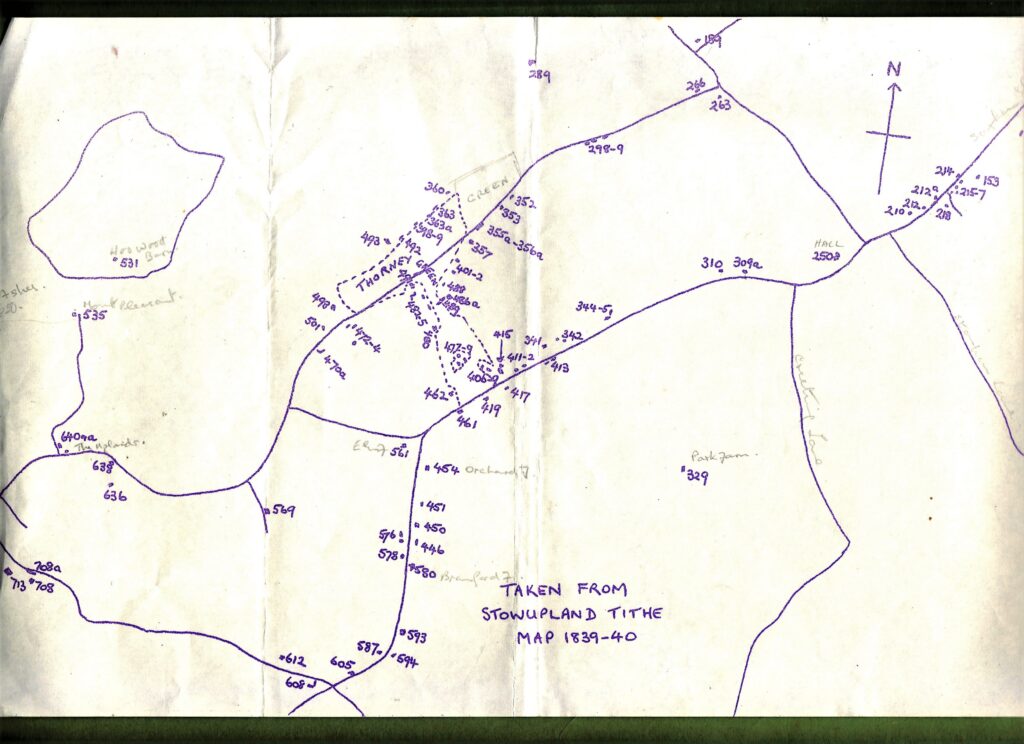
The main thoroughfares that form the roughly rectilinear shape of Stowupland have remained unchanged for centuries but as the volume and type of traffic has changed and increased there have been some changes to the roadways that link us to neighbouring towns and villages. ( Sketch map found in Ena Carter’s documents on which she noted many of the properties recorded in the 1840 tithe apportionements.)
Saxham Street, at the North Easterly extremity of the road layout is still linked to Mill Street by the historic route of the Main Road (or Church Road) though now known as the A1120. In the 20th century the Saxham Street junction with Bells Lane (the continuation of the A1120 from Stowupland down to Earl Stonham ) was changed. Previously a T-junction with a sign pointing along Bells Lane indicating @To the Coast’ the A1120 is a now sweeping curve with a turnoff to Mendlesham.
Gipping or Back Road, before the coming of motorised vehicles was more of a trackway across the village Green linking Pooles Farm to Columbine Hall. One 18th century map refers to it as Old House Road or Lane. What is not known is whether the old house is Columbine Hall or an property that previously stood where Trinity Walk is today.
Rendall Lane (occasionally known as Randall Lane) is little more than a single lane track linking Saxham Street in a north easterly direction up to Gipping Road. Up to the 19th century Watch Bench Lane linked Rendall Lane and Creeting Lane.
Mill Street, still exists as shown in the lower section of this map. It linked the southern extremity of Stowupland to Stowmarket and the River Gipping. With the coming of the A14 Mill street became a cul-de-sac, and traffic to Stowmarket has to find an alternative route.
Running westerly from the Elm Farm end of Mill Street is the Stowmarket Road (B1115). As shown on this sketch map at the junction with the road to Thorney Green, traffic heading to Stowmarket used to make a sharp left hand turn, In the 20th century this junction was changed and a new road built taking traffic straight across over and over a bridge across the A14 before traveling down Preston’s Hill into Stowmarket.
Thorney Green Road links the Stowmarket Road (B1115) to the Green.
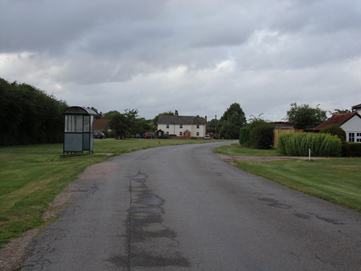
The Front Road or portion of the A1120 that passes through Stowupland village. Along this road can or could be found a pub, a couple of farms, the village post office, a forge, two schools, the village shop and garage, the URC chapel, Holy Trinity Church and the Village Hall. This helps account for the variety of names that have been associated with the carriage way e.g. Crown Hill, Stonham Road, Mendlesham Road, Pitman Road, Saxham Street, Church Road or Church Walk. Prior to a sharp right hand bend can be found Rendall Lane off to the north, whilst the A1120 continues to the South, being previously known as Stonham Road or Bells Lane.
,

In 1970 the East Suffolk County Council published plans for a new road linking the A45 to the ‘planned Gipping bypass’, although the road as planned would bypass the village it would have gone through these gentlemen’s back gardens and come out near the school. Mr R. Wright, headmaster of the school said, ‘ it will be very dangerous for the children. it is incredible that someone could think of such a ridiculous plan.’
‘An alternative route recommended by the Ministry of Transport cuts through an apple orchard and joins the A1120 near the village housing estate’. (Broomspath Estate) {EADT August 28th 1970:housing}
In his unpublished memoir ‘As I Remember It’, Leslie Brame left us some interesting stories of road sufaces and surfacing in the 1920s and 30s.
He recalled his family’s cycle trip across to Shrubland Hall. On the way back he fell off his bike which he blamed on being distracted by his father telling hom that ‘although granite chips took a long time to settle into a reasonable surface they were a lot better than the old flint chips that used to surface the road. We might have had a dozen punctures to fix by now in the old days. You can unerstand why they used flint: flintstones are local, and that’s why a lot of churches were built with round flintstones, and stone corners.
‘And then you have to remember, before rubber tyres came in on bicycles, all the carts and carriages had steel tyres on their wheels, and their horses had steel shoes on their hooves… And flintstones were very hard, so they lasted a long time. but you should have seen them in the dark, sparking as they were struck by the steel horeshoes.’( p 101)
Leslie then added that a few years later most of the roads were tar-sealed which made them much safer and easier to cycle on. ‘The tar was poured from a boiler onto a layer of small granite chips, and then a layer of washed sand; as the road was used, the sand worked its way into the tar, making a reasonably good surface… until the heat of the sun caused the sand to ‘bleed’… And even the best surfaces road develpoed pot-holes…which could give a cyclist riding on 26-inch wheels an awful jolt, or even throw him/her.’ (p107)
Leslie concluded his memoires of Stowupland’s roads with a reminisence of watching heavy rollers being used to ‘macadamise’ roads. He described how a new road foundation had to be laid before granite chips which were pre-coated with tar were applied hot, and each layer was compacted with a heavy roller (using traction engines). And then road- side gutters had to be built to cope with the run off water after heavy downpours. He added he was sorry when the steam-engines that were originally used in the road making process were replace by diesel driven ones.
Changes to Road Layouts.
See also Lost and Found Roads
Although this is an 1880 map of Stowupland the road layout remained essentaily the same till the the late 20th century. The road along the bottom is today’s B1115, but twhilst traffic oday continues straight ahead where the guide post is marked, aas is shown here the road used to make a sharp left turn to Stowmarket. A remnant of the road still exists alongside the allotments but comes to a deadend at the A14.
As this map shows only footpaths cross the Green. Today there is a proper road passing left to right across the green also one passing to the left of the windmill to meet the crossing path. Mnay of the other dotted paths crossing the green are now hard surfaces.


Before the A1120, traffic from Stowmarket that wanted to avoid crossing Thorney Green might drive along Mill Street and turn right before turning left to drive past the garage.
When the Stowmarket bypass was built and the A1120 created, the B1115 passed between these rows of trees. As the A1120 became busier a new junction was built. In 2023 this had to be widened to create 2 lanes, one for traffic turning left and one for traffic turing right.
see also Road Traffic Incidents.
